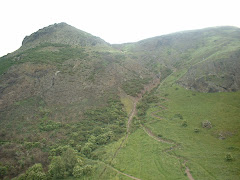
Long long ago children, there was a volcano in the area that we now know as Edinburgh, and it erupted spewing molten lava all over the place, but particularly in two big piles. Over the years this cooled and was covered by other stuff until, during an ice-age, a big glacier rolled over the landscape, simultaneously stripping off the layers of other stuff from the piles of volcanic rock and creating the valley which runs east to west through what is now the city centre. The pile of rock on the west end of the city is the thing they built the castle on top of, the pile of the east is now Arthur's Seat (presumably King Arthur but no-one seems to know much about this) and the valley became a loch, which was drained and where now sit Waverley Station and the gardens south of Princes Street.
In the National Gallery of Scotland (where we saw the Titian which has just been saved for the nation), there is a picture painted in seventeen hundred and something which portrays the castle and it is, indeed, sitting on top of a hill, overlooking a loch. Looking at this picture you can't help but wonder who first had the bright idea of draining the damn thing and to build a city in it's place. Did some-one turn up at the parish council meeting one day and say "I've had a great idea !". Who took him seriously? How do you drain a loch?? Where does the water go? How do you know that there's not a water source below which will refill it as fast as you empty it?
Anyway, they did it and Edinburgh exists, a city dominated by the castle on top of the hill.
Except, really, to truly dominate something you do have to be, at the very least, visible. The day we arrived was grey and, from street level, the castle was shrouded in low cloud. As we walked around the west bank, it became no clearer. We decided to see how close we could get and still not be able to see it. As it turned out, we managed to go into car park of the castle itself (the bit where all the marching up and down goes on in the Tattoo) and still we couldn't see anything as illustrated in the photo I published early. Please keep up! .
This may be military brilliance of course. Obviously, if you are Scottish and you build a castle, it will only be a matter of time before we English attack it. But if you make it invisible, then you could lure a hapless English enemy into a trap - the opposing army wander around blindly peering up at the skyline, while you tip boiling hot oil down on their heads.
Unable to enjoy the full glory of the castle, we decided to come back the following day to have a better look, and set off down the Royal Mile, running through the old part of the city between the Castle at one end and Holyroodhouse at the other, which is a palace that sits beneath Arthur's Seat and was built mainly for Charles II because he didn't like staying at the castle (either because it was too cold - we can vouch that it is cold - or because he couldn't find it in the mist).
The following day was clearer and by the time we get back up the hill, there was blue sky. And F finally got to see the castle which is, indeed, impregnable looking. There's lots to see in the castle including St Margaret's chapel (it's a great thing to stand in a small room that some-one built in 1100), the very moving Scottish National War Memorial room (it made me cry), the Great Hall, the room where Mary Queen of Scots gave birth to James I, the Scottish crown jewels (re-discovered by Sir Walter Scott, a feat which more likely explains why a 200ft gothic spire has been erected in his honour in Princes Street, than the fact that he wrote "Rob Roy" a novel which no-one has ever read), the stone of destiny (formerly The Stone of Scone) and Mons Meg.
Mons Meg is a massive cannon made in 1455. It took 100 men to drag it into position and they could only move it two miles a day. It was capable of hurling a 5 cwt stone ball about a mile and a half. In it's day it was an awesome weapon...
Except that, (and I speak as a military strategist myself obviously,) if you knew all that, then surely the smart move would be to position yourself one and nine sixteenths miles away from it, also moving two miles a day but with considerably more ease than the poor blighters who had to drag the blasted thing around. However, when I suggested this to the uniformed officer who happened to be standing next to me, I was met with what I can only describe as a stony silence. That will be the last time I try to be helpful to a Scotsman ;-)
Later we walked down to the Grassmarket where there is a small raised platform on the spot where they used to hang people. Next to this is a pub named after a woman who, having been hanged and placed in the body cart, woke up. This illustrates, we were told, an interesting distinction between English and Scottish law. In England, you would be taken and "hanged until you are dead". In Scotland, in contrast, you would be taken and "hanged". In our womans case, the fact that she was not dead did not mean that the sentence had not been carried out and she was therefore free to go and open a pub. Had all this happened in England she would have had to go around for another go.
One thing we did that I especially enjoyed was a trip below ground where there are still preserved medieval houses and streets. It is an amazing experience. You can get a rough idea of the size and shape of the accomodation (tiny) but it's impossible to imagine what life was really like. The street is very steep and narrow. With buildings ten plus stories high, there would have been little light. And this was one of the busiest trading streets in the old city - full of stalls, people, livestock etc, claustrophobic beyond imagining. And worse, there was no proper sanitation, which meant that sewage was tipped into the street (bad enough if you live at the top of the hill, but at the bottom......) and flowed down the hill, as it turns out, into the loch which some-one wanted to drain two hundred years later for reasons that we suddenly better understood.
Apart from no space, no sanitation, no daylight and no comfort, they also had the plague which killed a third of the population until, as in London, it was wiped out by fire. Rough times indeed. And can you think of a worse job in the 17th century than being the guy charged with disposing of the plague dead? It makes being a child protection social worker sound like a walk in the park in comparison. And speaking of walks in the park - or in this case the gardens - Princes Gardens have the most beautiful tulips....although I don't know about that wallflower...she could at least try to look as though she is having a good time! (Which she very definitely was.)